
World · Wall Street in Turmoil
Wall Street in Turmoil: VIX Surges to 35 as AI Stocks Crash, Raising Fresh Concerns for Indian Markets
Wall Street faces a sharp sell-off as AI stocks tumble and the VIX surges to 35. Here's what triggered the global market turmoil and how it could impact Indian markets, FIIs, IT stocks and investors.
By Raghuvir MishraFinance editor
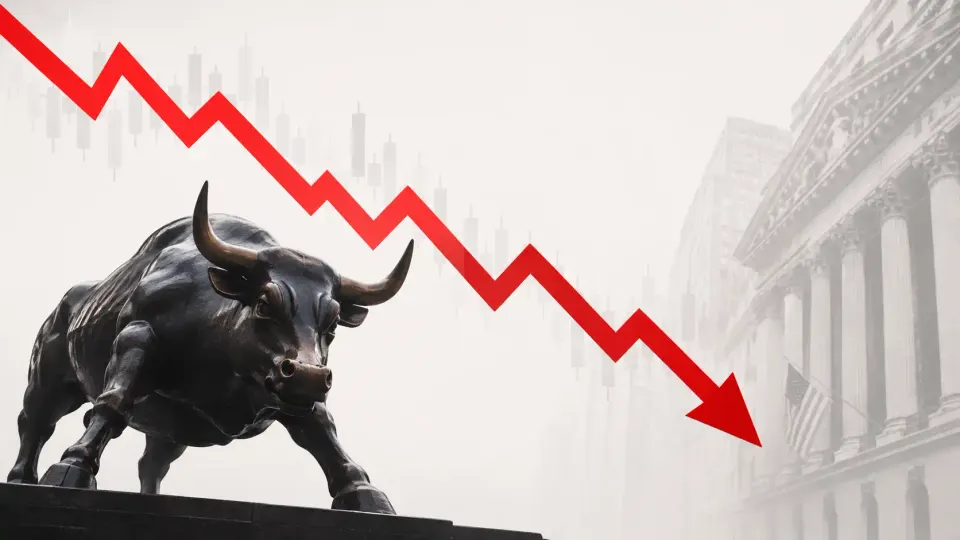
Wall Street witnessed a brutal trading session on Friday, November 20, as a sharp sell-off in technology and artificial intelligence (AI) stocks triggered widespread losses across major US indices. The scale of the decline, accompanied by a dramatic spike in market volatility, has raised fresh concerns about the sustainability of the global AI investment boom and its potential consequences for emerging markets, including India.
The Nasdaq Composite plunged 5.28%, while the S&P 500 declined 3.70% and the Dow Jones Industrial Average lost 1.93%. Adding to investor anxiety, the CBOE Volatility Index (VIX), popularly known as Wall Street's fear gauge, surged to 35.89, briefly approaching the 40 mark during the session.
The sell-off reflects more than a temporary bout of profit-booking. Investors are increasingly questioning whether the enormous valuations attached to AI companies are justified by their actual earnings potential, whether technology giants can sustain their massive capital expenditure and whether interest rates in the United States will remain higher for longer.
For India, the developments carry considerable significance. A prolonged correction in global equities could influence foreign institutional investor (FII) flows, currency movements, technology-sector earnings and overall market sentiment.
The bigger question now is whether Wall Street is witnessing a valuation-driven correction or the beginning of a more prolonged period of global financial uncertainty.
AI Investment Boom Faces a Reality Check
Artificial intelligence has emerged as one of the biggest drivers of global equity-market returns over the past few years. Companies involved in semiconductor manufacturing, cloud computing, data centres and AI infrastructure have attracted enormous investor interest.
The enthusiasm has been fuelled by expectations that AI will transform industries, improve productivity and create entirely new revenue opportunities.
However, investors are beginning to scrutinise the financial returns expected from the billions of dollars being invested in the technology.
Major technology companies are committing substantial capital towards advanced processors, data centres, electricity infrastructure, networking equipment and computing capacity. While these investments could deliver significant long-term benefits, the commercial returns may take years to materialise.
This has created an increasingly important question for investors: Are technology companies spending on AI infrastructure faster than they can generate meaningful revenue from it?
The concern is not necessarily that artificial intelligence will fail to deliver on its promise. Rather, investors are reassessing whether current market valuations already reflect too much of the industry's expected future growth.
When expectations become excessively optimistic, even financially strong companies can experience sharp corrections as investors become less willing to pay premium valuations for future earnings.
Semiconductor Stocks Lead Wall Street's Decline
The semiconductor industry was among the hardest-hit segments during Friday's trading session.
Major companies, including Nvidia, AMD, Micron and Broadcom, faced substantial selling pressure as investors reassessed the outlook for AI-related capital expenditure and future profitability.
Nvidia reportedly declined approximately 14% during the session, highlighting the intensity of the selling pressure in a sector that has been central to the global AI investment narrative.
These companies have benefited enormously from rising demand for AI computing infrastructure. However, their valuations have also reflected expectations of sustained growth in AI-related spending.
Any indication that technology companies could moderate their investment plans or that the returns on AI infrastructure may take longer to emerge can trigger significant changes in investor sentiment.
The concentration of market gains in a relatively small group of large technology companies has also increased the vulnerability of major indices to sector-specific corrections.
When heavily weighted technology stocks decline sharply, the impact extends beyond individual companies, affecting index performance, institutional portfolios and broader investor confidence.
Why US Interest-Rate Uncertainty Is Adding to the Pressure
Apart from concerns surrounding AI valuations, uncertainty over the future direction of US interest rates has added another layer of pressure to equity markets.
Inflation concerns and the possibility that borrowing costs could remain elevated for longer have forced investors to reassess the attractiveness of high-growth stocks.
The relationship between interest rates and equity valuations is particularly important for technology companies.
Many high-growth businesses derive a significant portion of their valuation from earnings expected several years into the future. When interest rates rise, the present value of those future earnings declines because investors apply a higher discount rate.
Higher interest rates also make relatively safer investments, such as government bonds, more attractive compared with expensive equities.
This creates additional pressure on technology and AI companies whose valuations depend heavily on expectations of substantial future growth.
Consequently, even without a deterioration in their underlying businesses, these companies can experience significant share-price corrections when interest-rate expectations change.
VIX Surges to 35.89: Why Wall Street Is Nervous
One of the most closely watched developments during Friday's market turmoil was the sharp increase in the CBOE Volatility Index.
WALL STREET VOLATILITY INDICATOR
CBOE Volatility Index (VIX)
Elevated volatility
35.89
Reported level during Friday's sell-off, November 20
Intraday level
Approximately 40
Market significance
Heightened uncertainty
The VIX measures the market's expectation of volatility in the S&P 500 over approximately the next 30 days, based on options prices. It is commonly referred to as the fear index because it tends to rise when investors anticipate larger market movements.
A reading around 35–40 indicates that investors are pricing in substantially higher volatility than during relatively calm market conditions.
The surge reflects growing demand for portfolio protection, heightened uncertainty and substantial movements in equity prices.
Institutional investors frequently use options to hedge against potential market losses. When demand for such protection increases, options prices can rise, pushing the VIX higher.
Certain systematic investment strategies may also amplify market movements. Volatility-targeting funds and other risk-management strategies can reduce equity exposure when market volatility increases, potentially adding to selling pressure.
However, a VIX above 30 does not automatically signal a financial crisis. It indicates elevated market uncertainty and the possibility of larger price movements.
The more important question is whether volatility remains elevated and begins spreading into other parts of the financial system.
Is the Wall Street Sell-Off a Warning Sign for India?
The correction in US markets could have important implications for Indian financial markets, particularly if global investors continue reducing exposure to riskier assets.
India is increasingly integrated with international capital markets. Consequently, developments in the US can influence domestic equities through foreign investment flows, currency movements, global growth expectations and investor sentiment.
One of the immediate concerns is the possibility of foreign institutional investors reducing their exposure to emerging markets.
During periods of global uncertainty, international investors often reassess their portfolio allocations and shift capital towards assets they perceive as relatively safer, including US dollar-denominated investments.
Such a move can create selling pressure in emerging markets, including India.
Indian equities with significant foreign institutional ownership could face additional pressure if global risk appetite deteriorates.
However, it is important to distinguish between foreign investors selling Indian equities because of global portfolio adjustments and selling because of concerns about India's domestic economic fundamentals.
These are two different developments, with different implications for the Indian economy.
Indian IT Companies Could Face Pressure if Global Spending Slows
A prolonged global economic slowdown could create challenges for India's technology services industry.
Indian IT companies generate a substantial portion of their revenues from international clients, particularly businesses in the United States and Europe.
If global companies become more cautious about spending, they may delay technology projects, reduce discretionary expenditure or reconsider outsourcing budgets.
This could affect the business outlook for major Indian IT companies, including:
TCS: Could face pressure if international clients delay large technology transformation projects.
Infosys: May experience slower deal conversion if clients become more conservative about discretionary technology spending.
HCLTech: Could be affected by changes in global enterprise technology and infrastructure expenditure.
Wipro: May face challenges if international clients reduce consulting and technology budgets.
Tech Mahindra: Could encounter pressure if global telecom and enterprise clients moderate spending.
However, the impact will vary depending on individual companies' client exposure, order pipelines, service offerings and ability to maintain margins.
There is also another side to the story.
The growing adoption of artificial intelligence could create new opportunities for Indian IT companies through AI integration, cloud migration, automation and enterprise technology services.
The challenge will be whether these opportunities can offset any slowdown in traditional technology spending.
Could a Global Market Correction Put Pressure on the Indian Rupee?
Another important channel through which global market weakness could affect India is the currency market.
During periods of heightened uncertainty, demand for the US dollar can increase as investors seek relatively safer and more liquid assets.
If this trend continues, emerging-market currencies, including the Indian rupee, could face depreciation pressure.
A weaker rupee can increase the cost of imported goods, particularly crude oil and other commodities priced in dollars.
For an economy that remains significantly dependent on energy imports, sustained currency depreciation can create additional inflationary pressures.
At the same time, a weaker rupee may benefit export-oriented companies that earn a substantial portion of their revenues in foreign currencies.
However, the overall benefit depends on hedging arrangements, operating expenses and the currency composition of individual businesses.
Could the Correction Create Opportunities for Indian Investors?
While a sharp global sell-off naturally raises concerns, it can also create opportunities for long-term investors.
Market corrections often bring valuations closer to levels that better reflect underlying business fundamentals.
For investors with a longer investment horizon, this could create opportunities to identify fundamentally strong companies trading at more reasonable valuations.
However, falling share prices alone do not make stocks attractive.
Investors need to assess earnings visibility, balance-sheet strength, cash-flow generation, debt levels and the sustainability of business growth.
A company experiencing a valuation correction despite stable earnings prospects is fundamentally different from one whose business outlook is deteriorating.
If the global sell-off remains concentrated in high-valuation technology stocks, its impact could be relatively contained.
However, if it spreads into credit markets, corporate financing conditions and broader economic activity, the consequences could become significantly more serious.
Five Indicators Investors Should Watch in the Coming Weeks
The direction of global financial markets will depend on how investors respond to the current uncertainty.
For Indian investors, the following indicators will be particularly important:
VIX: Whether volatility begins declining or remains elevated could indicate whether investor confidence is returning.
Nasdaq and S&P 500: Stabilisation in major US indices, particularly technology stocks, could improve global risk appetite.
US Treasury yields: Changes in bond yields will provide clues about interest-rate expectations and investor demand for safer assets.
FII investment flows: Continued foreign selling could increase pressure on Indian equities.
USD/INR exchange rate: Currency movements will help indicate whether global risk aversion is translating into pressure on emerging-market currencies.
Investors should also monitor credit spreads and broader financing conditions. A deterioration in credit markets would be a more concerning development than an equity-market correction alone.
Market Correction or the Beginning of a Bigger Crisis?
The sharp decline on Wall Street is undoubtedly significant, but it would be premature to interpret it as the beginning of a global financial crisis.
The immediate concerns appear centred on AI-related valuations, technology-sector spending, interest-rate expectations and investor positioning.
However, the situation deserves close attention.
If weakness remains concentrated in expensive technology stocks, markets could eventually stabilise as valuations adjust and investors reassess earnings prospects.
The risk would become substantially greater if the sell-off spreads into credit markets, corporate borrowing, banking liquidity and broader economic activity.
For India, the coming weeks will be important in determining whether the global correction translates into sustained pressure on domestic equities or remains largely an external market event.
Ultimately, the central question facing investors is no longer simply whether artificial intelligence will transform the global economy.
It is whether the enormous investments being made today will generate sufficient financial returns to justify the valuations investors are paying.
The answer could determine whether the current Wall Street turmoil remains a sharp market correction or develops into a more prolonged period of global financial uncertainty.
About the author
Finance editor
I am a finance and capital markets enthusiast with a keen interest in global markets, economic developments, and their impact on investors and businesses. Through my articles, I aim to simplify complex financial and market-related developments into insightful, fact-driven and reader-friendly stories that help readers better understand the evolving financial landscape.
Related stories
China Backed Pakistan
China Backed Pakistan During Operation Sindoor to Curb India's Rise, US Congressional Report Warns
5 hr ago
Indian-Origin Couple Shot Dead
Indian-Origin Couple Shot Dead Outside Canada Walmart; Police Probe Suspected Organised Crime Link
5 hr ago