
World · China Backed Pakistan
China Backed Pakistan During Operation Sindoor to Curb India's Rise, US Congressional Report Warns
China's military support for Pakistan during Operation Sindoor was part of a broader strategy to constrain India's growing economic and military influence, according to a new report by a US Congressional commission. The assessment has raised fresh concerns about Beijing's strategic partnership with Islamabad.

By IPV Desk
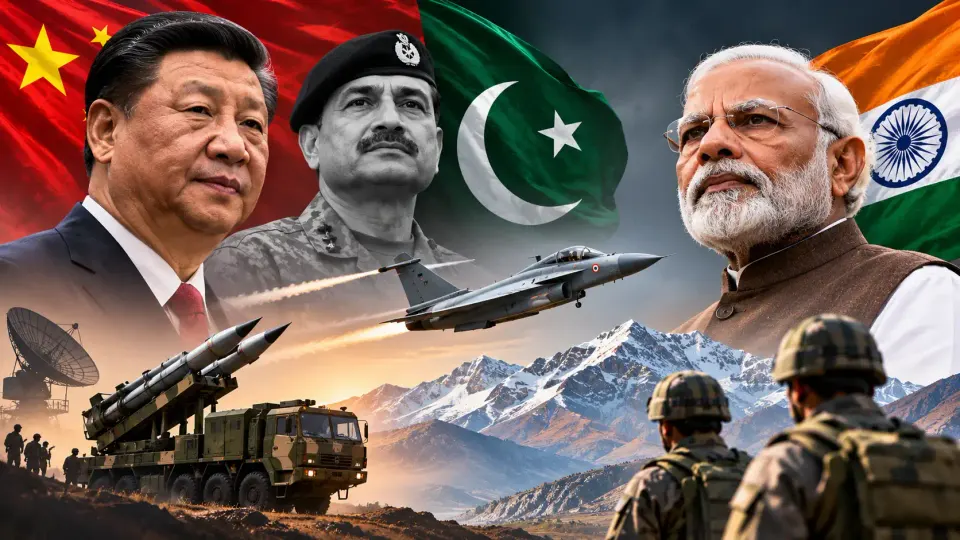
The findings were published in the 2026 Annual Report to Congress by the US-China Economic and Security Review Commission (USCC), released on November 18. A chapter titled China's Other Front: India and the Future of US Strategy in the Indo-Pacific examines how Beijing is using military cooperation, economic leverage and expanding regional influence to challenge India's emergence as a major power.
The report identifies India as one of the few countries outside the US alliance system with the economic, military and demographic scale to compete with China. It argues that Beijing views India's rise as a strategic challenge and is attempting to restrict its development across multiple areas.
China-Pakistan Military Partnership Raises Two-Front Security Concerns
One of the report's most significant findings concerns China's growing defence relationship with Pakistan, particularly during the military confrontation that followed India's launch of Operation Sindoor in May 2025.
India launched Operation Sindoor following the April 22, 2025, terrorist attack in Pahalgam, Jammu and Kashmir, in which 26 people were killed. Indian forces subsequently conducted strikes against terrorist infrastructure in Pakistan and Pakistan-occupied Kashmir, triggering a military confrontation between the two neighbouring countries.
According to the US commission, Pakistan reportedly used advanced Chinese-origin military equipment during the fighting. The report argues that China's longstanding military support for Pakistan has increased India's concerns about a potential coordinated or opportunistic two-front security challenge.
It further notes that the May 2025 confrontation demonstrated how Beijing could strengthen Pakistan's military capabilities during a crisis without directly entering the conflict.
Chinese Engineers Provided Technical Support in Pakistan
The report also highlights China's admission that its technical personnel provided on-site assistance to Pakistan during the Operation Sindoor confrontation.
In May 2026, Chinese state broadcaster CCTV aired an interview with Zhang Heng, an engineer associated with the Chengdu Aircraft Design and Research Institute of the Aviation Industry Corporation of China (AVIC).
During the interview, Zhang confirmed that he and other AVIC personnel had provided technical support in Pakistan during the May 2025 conflict.
The development is significant because it provides an indication of direct technical involvement by Chinese personnel during the period of heightened military tensions between India and Pakistan.
However, allegations that China also supplied real-time satellite intelligence or operational targeting information to Pakistan remain a separate issue. These claims have not been independently established by the commission.
China Is Also Using Economic Pressure Against India
Beyond military cooperation with Pakistan, the US commission identifies economic dependence as one of Beijing's most important instruments for constraining India's development.
The report argues that China is leveraging its dominance over critical industrial inputs, manufacturing equipment, technology and specialised expertise to make it harder for India to build competing domestic capabilities.
It highlights restrictions affecting several important industries, including electronics manufacturing, electric vehicle batteries, rare-earth magnets and pharmaceuticals.
The report also examines restrictions on the movement of specialised Chinese engineers and manufacturing equipment to Foxconn's Indian facilities. These restrictions reportedly affected India's efforts to expand advanced electronics manufacturing and highlighted the continued dependence of Indian factories on Chinese technical expertise.
For India's manufacturing ambitions, the findings raise questions about how quickly domestic companies can reduce dependence on Chinese machinery, components and industrial technology.
Pharmaceutical Industry Among India's Vulnerable Sectors
The commission has also raised concerns about China's influence over pharmaceutical ingredients and the potential consequences for India's medicine manufacturing industry.
India is a major global supplier of generic medicines, but several manufacturers continue to depend on China for Active Pharmaceutical Ingredients (APIs) and Key Starting Materials (KSMs).
The report highlights aggressive pricing by Chinese producers across several pharmaceutical ingredients during 2025, creating additional competitive pressure on Indian manufacturers investing in domestic production capacity.
A US Congressional report alleges China supported Pakistan during Operation Sindoor and warns Beijing is using military, economic and strategic pressure to constrain India's rise.
It argues that China's control over essential pharmaceutical inputs could become an economic vulnerability for India, particularly if supply restrictions or pricing pressures affect domestic manufacturing.
The issue has implications beyond the pharmaceutical industry, as India plays an important role in supplying affordable medicines to international markets.
China's Growing Presence in the Indian Ocean
The US report also warns that China's expanding maritime presence could weaken India's strategic position in the Indian Ocean.
Beijing has increased its economic and infrastructure engagement with countries across South Asia, including Pakistan, Sri Lanka, Bangladesh and Myanmar.
The commission argues that Chinese investments in ports, maritime infrastructure and regional connectivity projects could provide Beijing with greater strategic influence around important international shipping routes.
For India, the growing Chinese presence in the Indian Ocean presents a challenge to its traditional regional influence and maritime security interests.
The report particularly highlights the strategic importance of monitoring Chinese naval and submarine activity in the region.
US Panel Calls for Stronger India-US Defence Cooperation
Against this backdrop, the commission has recommended deeper cooperation between Washington and New Delhi to counter China's expanding influence.
It has urged the US Congress to direct the Defence Secretary and Chairman of the Joint Chiefs of Staff to work with their Indian counterparts on strengthening maritime and undersea domain awareness.
The recommendations include greater intelligence and surveillance sharing, joint monitoring of Chinese naval and submarine movements, and improved coordination in responding to maritime security threats.
The commission has also proposed an Indo-American Strategic Leadership Exchange Programme to strengthen long-term relationships between emerging leaders in the defence, government, business and academic sectors of both countries.
The recommendations are proposals for congressional consideration and do not represent automatically adopted US government policy.
India Faces a Strategic Challenge Beyond Its Borders
The report's findings underline a challenge that extends beyond India's military rivalry with Pakistan or its longstanding border disputes with China.
Beijing's growing defence partnership with Islamabad, combined with its influence over critical manufacturing supply chains and expanding maritime presence, could create multiple points of pressure for New Delhi.
For India, the challenge will involve strengthening military preparedness while accelerating domestic manufacturing, diversifying critical supply chains and expanding strategic partnerships.
The US commission's assessment also highlights the importance of India's position in the broader balance of power in the Indo-Pacific, describing the country as an important potential alternative to China-led manufacturing and supply networks.
While the report does not establish that Beijing and Islamabad have a formal agreement to launch a coordinated two-front military operation against India, it warns that China's ability to support Pakistan during a crisis could complicate India's future security planning.
The larger message from Washington is clear: India's growing economic and military influence has become an important factor in the strategic competition with China, and how New Delhi addresses its military and industrial vulnerabilities could shape the regional balance of power in the years ahead.
Related stories
Indian-Origin Couple Shot Dead
Indian-Origin Couple Shot Dead Outside Canada Walmart; Police Probe Suspected Organised Crime Link
5 hr ago
Wall Street in Turmoil
Wall Street in Turmoil: VIX Surges to 35 as AI Stocks Crash, Raising Fresh Concerns for Indian Markets
22 hr ago